Heartbreak

In his book Consolations, the poet David Whyte defines heartbreak as unpreventable, the natural outcome of caring for people and things over which we have no control. He says that heartbreak begins when we are asked to let go but cannot. Heartbreak is how we mature.

He recommends we look for and befriend it because it is unavoidable. There is no alternative path.

Whyte’s description of the word is truthful and empowering. It moves the word from a position of weakness and frailty to one of somberness, respect, and acceptance. Knowing you’ve reached such a point means that what has asked you to let go is truly meaningful, and your love is real because only such conditions would result in heartbreak.

I also like that it can take so many forms: children, work, arts, and relationships.

Progress

Reflecting on the technological advancements of the past fifty-one years is nothing short of astonishing. When the United States landed a spacecraft on the moon, it was guided by a 70-pound computer that could perform 14,245 calculations per second. That was cutting-edge technology at the time. 

Today, Nvidia has introduced a graphics processor that is over 2.5 billion times faster and weighs little more than a book. The sheer scale of this improvement is difficult to grasp. 

Consider data storage: during the Apollo era, storing a terabyte of data would have cost an astronomical $1.7 billion in today’s dollars. Now, you can get that same storage capacity for just over $15. This drastic reduction in cost has revolutionized how we handle and store information.

The advancements don’t stop there. In August, researchers achieved a breakthrough by pushing data through a single fiber-optic cable at a staggering rate of 178 terabits per second. This speed is enough to transfer approximately 1,500 4K movies in the time it takes to say “one, Mississippi.” 

It’s remarkable to think that when the Apollo 11 astronauts returned to Earth, the concept of computer-to-computer communication was still in its infancy. The first such link, known as Arpanet, came three months later.

These technological leaps showcase the incredible pace of innovation. They also make us wonder: if we’ve come this far in just over fifty years, what marvels will the next fifty hold? The possibilities are endless, and the future is bound to be filled with even more astonishing advancements. Assuming we don’t destroy ourselves of course.

A Divided House

Yesterday, May 30th, marked a historic and troubling day in American history. Donald J. Trump was found guilty on over 30 counts, officially making him a felon. While the left is busy celebrating, I believe we’ve just witnessed the opening shots of the second American Civil War. This isn’t about Trump; it’s about a profound disconnect in our society, where any dissent is met with accusations of racism and bigotry. The left has forced every piece of nonsense down our throats — men can be women, Hamas are freedom fighters — and now has taken our country to the brink of becoming a Banana Republic.

“A house divided against itself cannot stand. I believe this government cannot endure, permanently half slave and half free.”

Abraham Linclon

This is not about Donald Trump. His potential victory won’t save us; it will only drag us further into chaos. Trump, undoubtedly, will seek vengeance, and while he might be justified, it sets a dangerous precedent. This is how our nation will operate moving forward, weaponizing the justice system against all political opponents. A second Civil War is the only way to avoid this grim fate. Accepting the state of a Banana Republic is no better than enduring the dystopian communist nightmare we currently face with the present administration.

Adding to the chaos, under the cover of night, our President Biden authorized Ukraine to use American weapons to strike deep into Russia. This move dangerously escalates tensions and brings us closer to a direct conflict with the world’s second-largest nuclear power. It feels like a nightmare that I can’t wake up from, yet it’s all too real. A reckoning is inevitable; if it doesn’t come, God help us all.

Resilient Futures: Navigating Disaster Recovery and Business Continuity

Part One: Foundation of Resilience: Why Leadership Must Drive Disaster Preparedness

Over the last couple of years I’ve talked and written about the importance of leadership, specifically non-technical stakeholders, having a central role in developing a data strategy. Too often, organizations leave their data strategy in the hands of technical teams, leading to robust and comprehensive data solutions that do not meet the needs of the stakeholders. Well, there is another area of technology where non-technical leaders/stakeholders need to be as central in the decision-making process: disaster recovery and business continuity.

Disaster recovery and business continuity seem like old-school topics that have been solved ages ago, yet sadly, the number of organizations that don’t have a reliable plan is more than most of us would want to admit. Here are some statistics that should give any executive the chills:

  • According to a 2021 study by Computing Research, only 54% of organizations have documented disaster recovery plans in place.
  • Of the organizations that do have a disaster recovery plan, a shocking 7% never actually test or validate their plans. Additionally, half of them only test their plans once a year or less frequently.
  • A study by IBM found that 77% of organizations don’t have a cyber security incident response plan that applies to the entire organization.
  • Research by Gartner revealed that only 35% of small and midsize businesses have a comprehensive business continuity plan in place.

Often, when an executive from the C-suite is asked if their organization has a DR/BC plan, the response is “Yes.” But when you ask them about their Recovery Time Objective (RTO) or Recovery Point Objective (RPO), they have no idea.

I cannot stress enough how important it is for leadership, specifically the C-suite, to actively engage in knowing and understanding their organization’s disaster recovery and business continuity plans, and critically, their RPOs and RTOs.

C-suite executives, regardless of their technical expertise, must understand their organization’s Recovery Time Objective (RTO) and Recovery Point Objective (RPO) to make informed strategic decisions, mitigate risks, ensure compliance, and effectively collaborate with IT teams. By actively engaging in comprehending these critical metrics, executives demonstrate leadership and commitment to safeguarding their organization’s operations, reputation, and financial stability in the face of potential disasters.

With some context around the problem, lets do a quick review of the concepts and terminology.

Quick Review

Now, it is important to note that disaster recovery and business continuity are distinct concepts, but they are closely intertwined. Business continuity encompasses a broader scope, including strategies to keep operations running during and after a disruptive event, while disaster recovery focuses on restoring IT systems and data.

In the context of DR, the Recovery Point Objective (RPO) is a key metric in disaster recovery planning that defines the maximum amount of data loss an organization can tolerate in the event of a disruptive incident or disaster. And Recovery Time Objective (RTO) is the maximum acceptable amount of time for restoring a network, application, or system and regaining access to data after an unplanned disruption or disaster event.

So what is the role of the c-suite executive in DR/BC planning?

It is the responsibility of the C-suite to provide clear guidance and direction to the technical teams tasked with implementing the DR strategy. This guidance should focus on three critical areas. First, executive leadership must identify and prioritize the business-critical systems that require zero or near-zero downtime. These are the systems that are essential to the organization’s ability to function and generate revenue. Second, leadership must define the acceptable amount of data loss during an outage, known as the Recovery Point Objective (RPO). This metric helps technical teams determine the frequency and scope of data backups. Finally, executive leadership must determine the acceptable amount of downtime before restoring critical systems, known as the Recovery Time Objective (RTO). This metric guides the development of strategies to quickly restore systems and minimize the impact of an outage. By providing clear parameters around these three key areas, executive leadership empowers technical teams to prioritize systems and develop appropriate DR strategies that align with the organization’s overall business objectives.

Now, equipped with the engagement and guidance of the leadership team around the priority of critical systems,RPOs and RTOs, the technical team can develop a robust DR strategy that will inform the BC strategy.  And a case for the value of the cloud can be made effectively.

In part two I will discuss the value proposition of a cloud-based DR solution using services from Amazon Web Services (AWS).  And provide some ideas around chaos testing for continuous improvements, and continuous monitoring and testing.

From The News

Kronos Private Cloud Outage (2021)

In December 2021, workforce management company Kronos suffered a crippling ransomware attack that took down its private cloud services used by thousands of businesses globally.

  • The outage disrupted payroll, scheduling and other workforce management operations for numerous companies across multiple industries.
  • Some major customers like the City of Cleveland and the University of Florida had to revert to manual timekeeping processes.
  • Kronos was unable to restore services from backups for weeks due to the severity of the attack.

The incident highlighted the company’s lack of resilient DR capabilities and contingency planning for such a scenario.

Previously published on LinkedIn

Ambling towards Armageddon (The Saving Democracy Edition)

I’ve been thinking about the war in Ukraine, obviously a proxy war between the US, NATO, and Russia. The constant, nauseating references to World War II and Putin as the new Hitler are disturbing and misguided. 

Putin is undoubtedly a ruthless, murdering autocrat, if not an outright dictator, balanced somewhat by Russian aristocrats and oligarchs. His regime is dangerous and to be feared, if not respected. But they’re not the Nazi regime.

It’s foolish to imply that if we don’t stop Putin now, he’ll do what Hitler did. It is important to note that the Allies didn’t go after Hitler because of the Holocaust — we might have known through intelligence, that there was a systemic annihilation of Jews and other peoples but that wasn’t the reason why England and the US went to war with Germany.  A fact that is overlooked.  We were at war because the Nazis challenged the Anglophile world order.

The Nuremberg laws were inspired by American race laws. Blacks in the US were treated with such indifference and hatred that I would argue we were one bad leader away from developing our own flavor of a Holocaust. The revelations of the Holocaust’s horrors held a mirror to post-war America and its treatment of blacks, which I believe enabled the civil rights movement to gain the traction it had lacked for decades. Without it, the holocaust, I believe progress in race relations would have been little to none.

We must be wary of the myths our leaders peddle with little to no context.  Especially when they are used to justify foreign entanglements.

World War II was an extension of World War I.  A war started in large part as an arrogant power grab by impotent leaders sacrificing the lives of millions of young men and civilians, with the net outcome of some changes in borders. The lack of consequences for any of the men responsible led to an even more horrific World War II.

Today’s leaders hide behind that false moral superiority. Leading us to a potential nuclear confrontation – an existential threat to humanity that we aren’t even upset about, preoccupied instead by petty issues like the “misuse” of pronouns.

Is preventing Putin’s potential tyranny over a small population worth risking all of humanity? If so, then why are we not doing the same for Haiti, the Congo, or South Africa?  Do some people count more than others?  We do nothing for these and many other countries but are willing to risk Armageddon for a conflict and people we barely understand – essentially for nothing.

How They Learned To Love The Bomb

Climate activists like those in this post lose all credibility with their misplaced sense of urgency when in they overlook the threat of nuclear war the world is facing with the US proxy war with Ukraine and Russia.

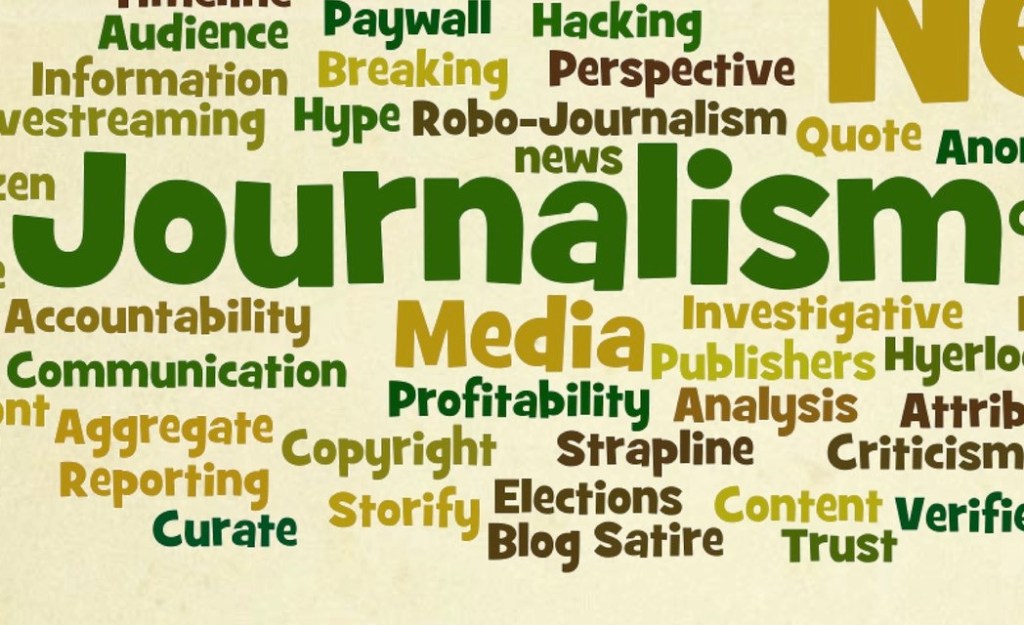
Good Journalism

“Journalism Notebook” by planeta is licensed under CC BY-SA 2.0.

I finally got to listen to The Free Press podcast of, The Witch Trials of J.K. Rowling. As of the writing of this post, the most recent episode is chapter 3– embedded in this post. I started to listen to chapter 1 thinking I would listen for about 20 min and pick up later and 3 hours later I am here posting about it because I wanted to note how impressive it is so far.

The series is written and narrated by Megan Phelps-Roper, whose own story is of interest on its own. But what she and her team have managed to produce in just three hours of podcasting is nothing more the first-rate, long-form journalism.

Not going to spend any time reviewing this work since it is not done. Just wanted to note that this is serious work for anyone that is a free thinker.