Rounding Error

Every time someone asks, “Where were you on 9/11?” It feels like a deeply personal question has been asked. As if someone was asking something intimate, a secret. The thoughts and emotions of that day, and the days that followed, were deeply personal. A whole nation had to come to terms with our vulnerabilities – as a country and as individuals – in a way we never had. It was an attack on a collective with intensely personal experiences.

Some people talk of that day and can come off as if they want to be a part of it some much that they dig hard to find a personal connection with it. “Well, I knew a guy whose brother knew a guy whose sister dated a guy who went to kindergarten with a guy that saw the building collapse.” Or, “I would have been on that very flight 9 years earlier… can’t believe I could have died on that plane.”

It’s been twenty years, and many 9/11’s have come and gone. But this one, this twentieth year, has hit me like none before. Not sure why. I don’t care to relive that day nor to recount my story. I experienced that day, so many years back, to the fullest. And at the end of the day, my experience is nothing more than a rounding error on the scale of life.

Much has happened since that September morning. Slogans of defiance have been turned into clichés. Men who stood up to the task of leadership on that day have become parities of themselves.
Hero’s have been mythologized, and victims eulogized. The cause for justice politicized. And while our enemies were defeated, new ones have taken their place. We said we’d “never forget,” but we have.

Seems like every generation has moments that define them, Pearl Harbor, Vietnam, 9/11, COVID. Peel back each event, and it reminds us that no matter how public, how collective the experience, in the end, it is always a deeply personal and intimate experience. No slogan or retelling of those events will change that fact. These events have one thing in common, they shape us whether we like it or not. We have as much control over their effects on us as we do of the events themselves. And that shaping of us is deeply personal, intimate.

Twenty years. Once experience. A rounding error on the scale of life.

You cant fake innovation

Photo by John T. Daniels  (1873–1948) Library of Congress‘s Prints and Photographs division
under the digital ID cph.3a53266.

John Daniels, a Kitty Hawk North Carolina resident took the photo of the Wright brother’s first flight, said of the brothers:

They were the “workingest boys I ever knew…It wasn’t luck that made them fly; it was hard work and common sense”

from How Innovation Works and why it flourishes in freedom by Matt Ridley

The notion of fake it till you make it has become too prevalent in our culture. So much so that what passes now as vision, leadership, excellence, and innovation is garbage because it is fake. When you fake it till you make it you are still faking it.

I think the mind-numbing state of affairs we are in is in large part a result of faking it till you make it. And when real problems demanded real vision, leadership, excellence, and innovation we have been left with a vacuum cause all we had/have is fake.

There is no substitute for hard work. And the Wright Brothers demonstrated that hard work, inspired by a vision, helped them settle for nothing short of excellence. And that fueled a level of innovation that all the money in the world failed to deliver on — just look up Samuel Pierpont Langley.

My News and Current Events Sources

Photo by Daria Shevtsova on Pexels.com

I have updated my stack of podcast to listen to that will take over what use to be my news viewing practice. Im listing them below. The list is heavily libertarian and I need to add a conservative and liberal podcast to balance out my information gathering and help me, to the best of my abilities, preempt cognitive dissonance.

News Sources

As for news sources I’m sticking to:

I find all other news sources too far off on their political bias. As I type Ive come up with an idea for rating news organizations similar to the way countries are assigned a credit rating of AAA when they are stable and trustworthy to full-fill their financial commitments. I’ll follow up with a post on what I settle on.

Digital Transformation’s Lessons From COVID

Among the many lessons to be learned from the COVID crisis, the one that stands out the most is the American workforce’s resilience.

One primary concern expressed by technology leaders and many stakeholders around digital transformation has been the impact these changes would have on their users’ ability to perform their tasks while adapting to new technologies. This is especially true when users are being introduced to platforms like Salesforce, Dynamics, O365, Teams, Slack, and many more.

Context Is Everything

The digital transformation approach has always been slow and steady. But while prudent, this approach can take a 3-month project and devolve it into a 3-year ordeal with frustrated stakeholders, staff, and an overworked technology team. I’ve spoken to countless CxO’s for whom the term digital transformation is a four-letter word.

The last year has shown that a narrowly scoped outcome with senior leadership’s unquestioning commitment is critical for a timely and successful digital transformation. And while everyone involved in a digital transformation project will confirm that their project has identified outcomes and complete commitment from the C suite, most of those projects have lacked the contextualization that COVID has provided; swim, or you will certainly sink.

Lessons Learned

Organizations need to start treating the lessons learned process as critical to their long-term success. Too often, this necessary process is often outright discarded to get to more “critical” work, or it is greatly declawed by not having any executive sponsor driving for actionable data. Organizations that set lessons learned from COVID as a primary objective for their organizations stand to gain a competitive advantage over those that don’t take this process seriously.

Adoption = Success

Finally, we cannot forget about the backbone of any organization, its people. On-going training programs are critical, but to drive success in any digital transformation project will require having partners and vendors with mature customer success programs that will help drive user adoption of the new tools. So when selecting a platform or a managed service provider, it is imperative that along with the tools and services, you have a good understanding of how their customer success program works and exactly how it will deliver value to your organization. And a sign of a mature program is one that continuously helps users with adoption.

On-The-Fly

After months of uncertainty and dire news reports, the American workforce has managed to deliver and exceed its productivity in many areas. I believe this is because leadership across organizations raised expectations for their staffs and their staffs answered the calls.

In 2020, for many organizations, the digital transformation happened on-the-fly, and as a result, they will be better positioned for the future. But organizations need to optimize these transformations into long-term cultural values that will allow them to build on the lessons learned and prepare them for the next unforeseen challenge. 

COVID came out of nowhere, and its disruption will be felt for years to come, but our workforce, while shaken, was not deterred, and that is an outcome that should provide us all with optimism for our future.

Not Alone

I had been a skeptic of anything UFO-related for years and enjoyed making fun of the whole culture and its adherents. But since the New York Times article on the subject from December 2017, I have become someone who now believes that we are and have been visited by aliens. I’ve spent the last three-years reading the literature on the matter, both good and bad, and what has continuously been leaked or revealed by government agencies and, most convincingly, navy pilots like David Fravor. And I have come to the conclusion that the evidence is solid and, up to now, indisputable. 

Lex Fridman has an excellent podcast with Fravor, and they go deep into what he saw as a pilot. Probably the most rewarding part of this interview is that Fridman spends the first hour getting to know the pilot as a person, and you get a great sense of what it takes to be a US Navy pilot. With his credibility established, the conversation moves towards what he saw. They spend a good amount of time discussing what the debunkers have said, and Fravor offers his own debunking of the debunkers. 

The is an overwhelming amount of bullshit out there relating to UFOs. But there is a consistent percentage of unexplained phenomena that fails to be satisfactorily explained. And the difference over the last 3-years has been the credible sources advocating for transparency on this matter; Senator Harry Reid, Chris Mellon, and John Podesta, to name a few.

Debunkers like to note that “extraordinary claims require extraordinary evidence” and quickly hide behind the notion the Einstein just can’t be wrong, so space travel is impossible. My retort to them is that “When you have eliminated the impossible, whatever remains, however improbable, must be the truth.”

I think that instead of declarations of certainty and attempts to ridicule, the best approach would be a comprehensive, scientific analysis of the phenomena.  

From the Ground Up

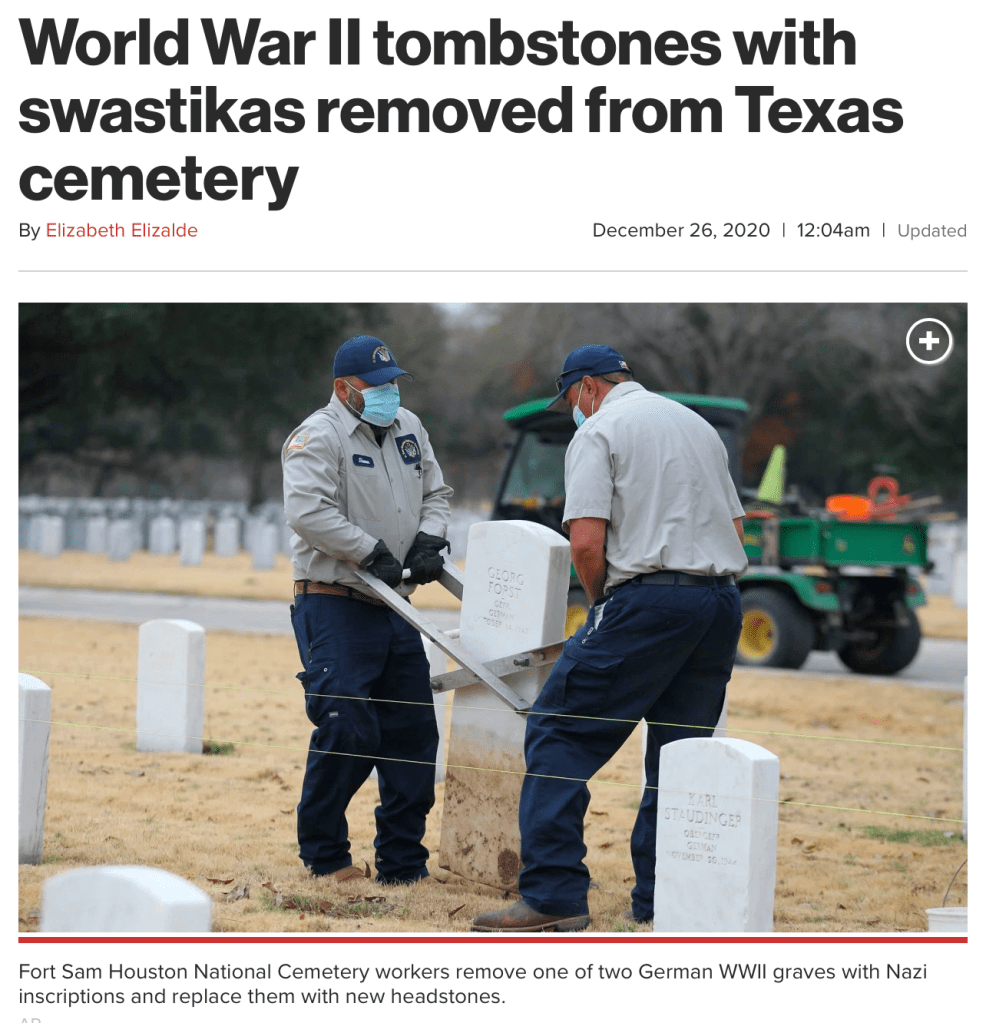
I found this seemingly blasé article disturbing because this is how erasing history starts—one “inconsequential” item at a time.

“Two German WWII tombstones at a Texas veterans cemetery — each bearing Nazi swastikas — have been removed and replaced with new ones that do not use the symbol.”

NYPOST.com

I’ve heard some of the reasons for the removal and replacing of these tombstones and found them to be nothing but straw men arguments:

  • Racist will flock to these sites — they can do so in their living rooms or garages.
  • It’s offensive to X people — being offended is not a protected right.

While reading this article, it reminded me of the fire chiefs monologue in Fahrenheit 451 (I’ve only included a small part of it, you can find the full speech here):

“Now let’s take up the minorities in our civilization, shall we? Bigger the population, the more minorities. Don’t step on the toes of the dog-lovers, the cat-lovers, doctors, lawyers, merchants, chiefs, Mormons, Baptists, Unitarians, second-generation Chinese, Swedes, Italians, Germans, Texans, Brooklynites, Irishmen, people from Oregon or Mexico. The people in this book, this play, this TV serial are not meant to represent any actual painters, cartographers, mechanics anywhere. The bigger your market, Montag, the less you handle controversy, remember that! All the minor minor minorities with their navels to be kept clean. Authors, full of evil thoughts, lock up your typewriters. They did. Magazines became a nice blend of vanilla tapioca. Books, so the damned snobbish critics said, were dishwater. No wonder books stopped selling, the critics said. But the public, knowing what it wanted, spinning happily, let the comic-books survive. And the three-dimensional sex magazines, of course. There you have it, Montag. It didn’t come from the Government down. There was no dictum, no declaration, no censorship, to start with, no!

Technology, mass exploitation, and minority pressure carried the trick, thank God. Today, thanks to them, you can stay happy all the time, you are allowed to read comics, the good old confessions, or trade journals”

A free society should not give in to pressures to erase our history. No matter how painful, violent, or embarrassing, we have to develop methods to cope and learn from past events, not hide them.

At first, glance, who gives a shit about two dead nazis? I certainly don’t. But where does it stop? Who decides what goes and what doesn’t?

If you haven’t read Fahrenheit 451 do yourself a favor and do so now.

My Take: Burning the Books

Burning the Books: A History of the Deliberate Destruction of Knowledge by Richard Ovenden does an excellent job at demystifying the stories behind the burning of the library of Alexandria. It makes a compelling argument that equally contributing to the demise of the legendary library was neglect and a deprioritization of knowledge in the society where the library was located.

Ovenden splits the book into two main areas of focus, libraries and archives. I found this interesting since I have never really given much thought to archives and their importance in preserving culture and histories. I did find that the author, after making a clear distinction between the two and noting that they are not mutually exclusive, then starts to use the terms interchangeably toward the last third of the book.

The chapters on the Yugoslavian war of the nineties and the destruction of Jewish libraries during World War II are insightful and a warning to all that take such events lightly. These chapters shed light on how burning libraries and archives is a deliberate tactic that often time precedes genocide.  

I found two problems with the book that irritated me:

First, towards the end of the book, the author focuses on the importance and need to archive as much of the social media content as possible and frames this need as a duty for future generations. I am skeptical of this premise. I understand and can see the insights that such an initiative can provide to future generations on how we think and what our priorities may or may not have been. But I also find the idea of creating repositories of such large volumes of commentary rubbish dangerous. Social media platforms give everyone a voice, and an exceeding majority of people tend to regret a lot of what they say. Achieving such moments can be embarrassing and dangerous to people in the future. Just recently, former Labor Secretary Robert Reich called for making a list of Trump supporters so that the country can embark on a series of truth and reconciliation hearings. And while national archives can serve as powerful tools for justice, the other side of that blade can serve as an instrument for prosecution for past opinions or support. Ovenden does not even admit a negative side to such archiving, which I found troubling. Is this omittance naivety or deliberate ignorance on his part?

Second, Ovenden does a good job bringing to light how many Europes libraries, including the Bodleian Library at the University of Oxford, have items on their catalogs that were acquired due to war and pillage. And while he seems to denounce the practice, he stops short of calling for the return of such items to their sources of origin. I found it rather annoying that he would bring the matter up but not offer his opinion. The case of manuscripts, works of art, and treasures acquired through imperialism and colonialism is a pressing matter that will gain momentum as more countries industrialize and move out of poverty. If western institutions had to return said collections, their museums and net value would plummet overnight. And while many of these institutions refraining from stating that they can care for these artifacts better than the people from where they originate (it would not be the politically correct commentary), their silence on the matter of what to do makes it clear that their liberal thinking only goes so far. I think that technology holds the key to preserving copies of these artifacts and making them accessible to the world at large.

While I have noted two issues that bother me about Burning the Books, I still think the project is well written, and its author is an accomplished scholar. This book should be in any bibliophile’s collection.

Unsubmissive Man

Photo by Rachel Claire on Pexels.com

Of the tree of knowledge
In the shadows of its memories
Stands the unsubmissive man

Mankind knew the legend 
Glory begins with eating the forbidden fruit
Adam was condemned 

Payment recorded
Payment recorded
Payment recorded

Torn by vultures because of his courage
Prometheus chained to a rock
He had stolen from the gods

Payment recorded
Payment recorded
Payment recorded

Of the tree of knowledge
In the shadows of its memories
Stands the unsubmissive man

Effort

Assessment requires more effort
He makes the assessment that requires the least effort
But effort was necessary
And he was wrong
He was wrong

Apollo 11 Deepfake

Trust is the foundation of any organization or society. In a time where news, opinions, and the public are delivered with a few clicks and without context. Deepfake technology poses a sinister threat to our way of life. The In Event of Moon Disaster project by MIT is engaging and sobering. The six-minute video is excellent! But its pho-thenticity is disturbing and a warning sign of things to come.

There are excellent resources on the site for an in-depth study of Deepfake technology. Governments will need to draft sensible policies around such techniques, and news organizations will need to develop a discipline around rushing to distribute videos without verifying their authenticity.

PREMIERE OF FULL FILM & COMPLETE SPEECH! In July 1969, much of the world celebrated the “giant leap for mankind” that the successful moon landing constituted. In 2020, nothing is quite so straightforward. In Event of Moon Disaster illustrates the possibilities of deepfake technologies by reimagining this seminal event. What if the Apollo 11 mission had gone wrong and the astronauts had not been able to return home? A contingency speech for this possibility was prepared, but never delivered by President Nixon – until now. The immersive project invites you into this alternative history and asks us all to consider how new technologies can bend, redirect and obfuscate the truth around us.

You can visit and access all the resources of this project by going to: https://moondisaster.org/