The mind is its own place, and in itself can make a heaven of hell, a hell of heaven. – Milton
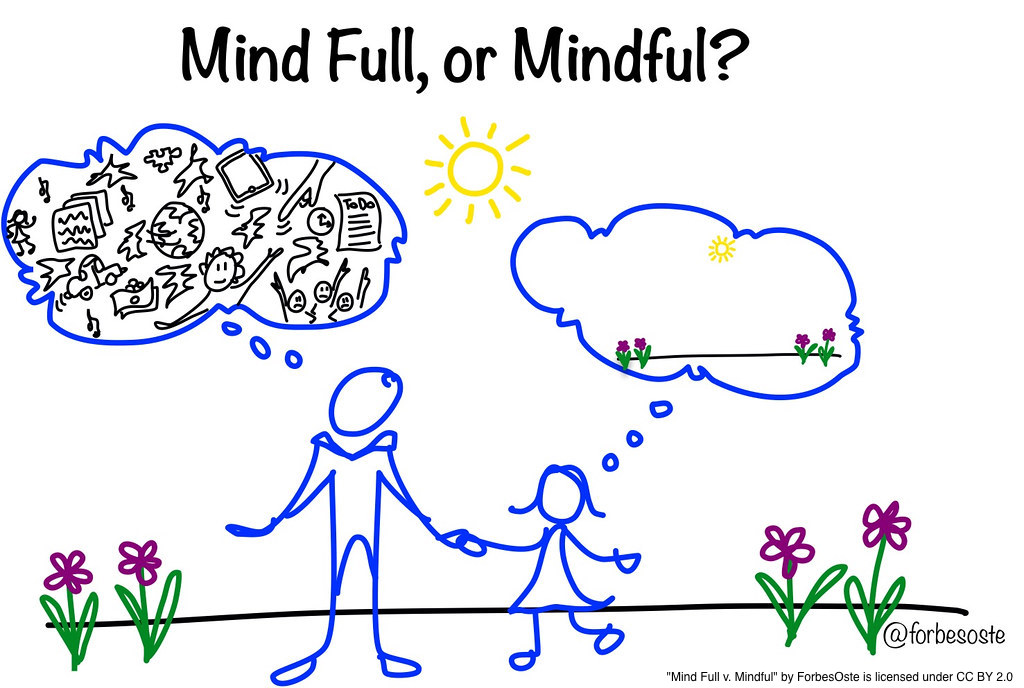
The mind is its own place, and in itself can make a heaven of hell, a hell of heaven. – Milton
You don’t lose if you get knocked down; you lose if you stay down — Mohamed Ali


The COVID-19 crisis will end. And when it does, there will be new challenges and opportunities for businesses to capitalize and exploit. The changes resulting from COVID-19 will be as profound and lasting as those from 9/11, and many will be as equally forgettable – facemask for one.
Perhaps the single most significant change on everyone’s mind is the case for working from home–remote work.
“From startups and tech giants to more old-school Wall Street firms, businesses are rethinking the role of office space and whether they even need it.”
Courtney Rubin, The Office is dead
In the Medium article, The Office Is Dead Courtney Rubin notes that changes are already taking place throughout organizations everywhere. The bottom line here is the bottom line. Organizations are coming to the conclusion that there are significant savings in having a remote workforce. Many experts say we are witnessing the passing of an age and the dawn of a new one. And like dinosaurs, super large headquarters will become extinct. I don’t think this is the case.
First, the increase in productivity being reported is not measured against a control group, let alone under normal circumstances. If we are honest with ourselves, we have to admit that a lot of the productivity we see from the sudden remote workforces is a result in part of the fear many have of losing their jobs during such a crisis. With large numbers of unemployed, few will take any chances to have their productivity or value questioned.
Second, it is easy to stay focused on work when everything else is closed, and your ability to do things outside the house is limited. But when gyms are open, restaurant dining (in and out) goes back to normal, happy hours are back in vogue, and little league and teen sports are rip-roaring in full stride, what are the chances that the remote workforce productivity stays consistent with what we have seen over the last six months? I know this statement seems cynical, but I would argue that its a reality we need to be ready to consider and honestly answer. Working remotely requires both individual and organizational discipline that is not coerced by external crises but driven by corporate culture and personal values. Even the language needs to be different. Instead of calling it remote work, a better term is distributed work.
On the March 24 2020, episode of the Making Sense podcast, Sam Harris has an engaging conversation with Automattic founder Matt Mullenweg, the topic; the evolution of distributed work. I recommend you take some time and listen to this episode. It will be time well spent and invested if you are someone who will be looking into capitalizing on this new opportunity and are considering enabling a distributed workforce.
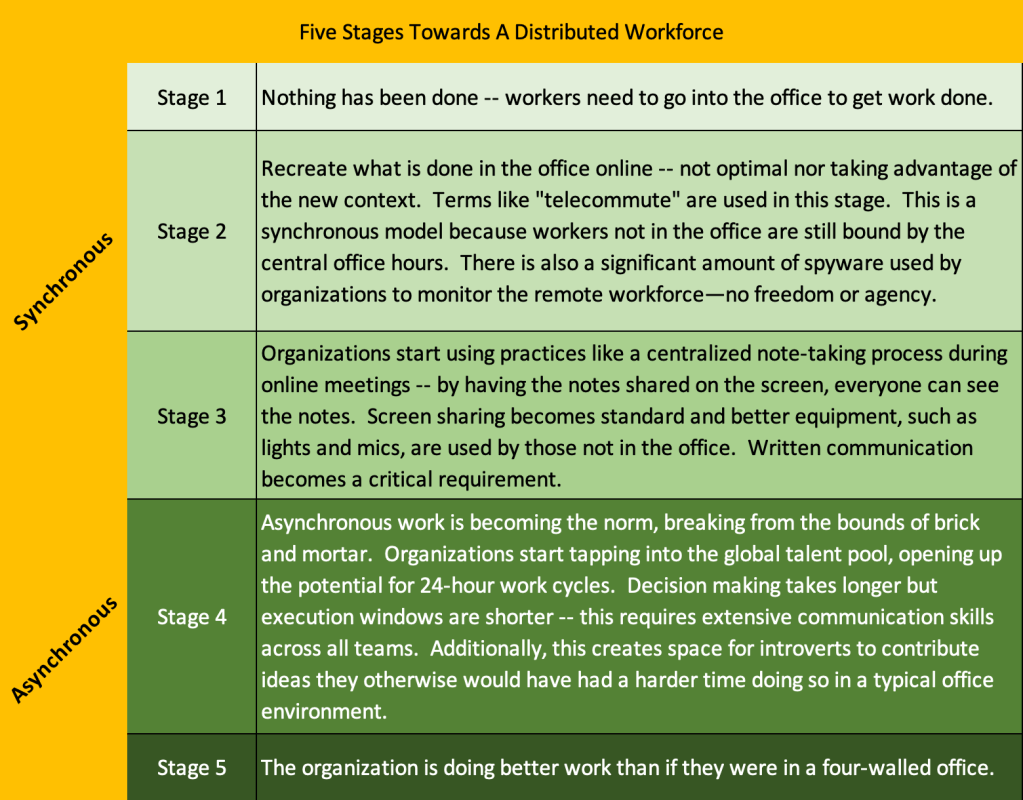
Mullenweg and his organization have executed what I think is one of the best frameworks for a distributed workforce. Below I have included my notes from the podcast. (At the end of the post Ive included a table with the notes):
Stage 1 – Nothing has been done — workers need to go into the office to get work done.
Stage 2 – Recreate what is done in the office online — not optimal nor taking advantage of the new context. Terms like “telecommute” are used in this stage. This is a synchronous model because workers not in the office are still bound by the central office hours. There is also a significant amount of spyware used by organizations to monitor the remote workforce—no freedom or agency.
Stage 3 – Organizations start using practices like a centralized note-taking process during online meetings — by having the notes shared on the screen, everyone can see the notes. Screen sharing becomes standard and better equipment, such as lights and mics, are used by those not in the office. Written communication becomes a critical requirement.
Stage 4 – Asynchronous work is becoming the norm, breaking from the bounds of brick and mortar. Organizations start tapping into the global talent pool, opening up the potential for 24-hour work cycles. Decision making takes longer but execution windows are shorter — this requires extensive communication skills across all teams. Additionally, this creates space for introverts to contribute ideas they otherwise would have had a harder time doing so in a typical office environment.
Stage 5 – The organization is doing better work than if they were in a four-walled office.
Reaping the benefits of an office-less organization will require knowing how to orchestrate asynchronous performance. And while the backbone of such a framework is almost all technology base, organizations need to be mindful of the context their staff will be operating in and how that impacts or enhances the companies culture. Trusting their employees will work without intrusive tools is only the first step in designing a culture that succeeds. Effective writing skills will be up there with whatever technical specific skills are needed for each role.
The proclamations of the end of office spaces as we know it is nothing more than hyperbole. I suspect that while there will be more people working from home, the numbers won’t be as high as experts say it will. Few companies will be able to deliver on a real distributed workforce model. But the ones that do will have a cultural-competitive advantage over the ones that don’t or cant.
Fear prophets, Adso, and those prepared to die for the truth, for as a rule they make many others die with them, often before them, at times instead of them. – William of Baskerville, The Name of The Rose

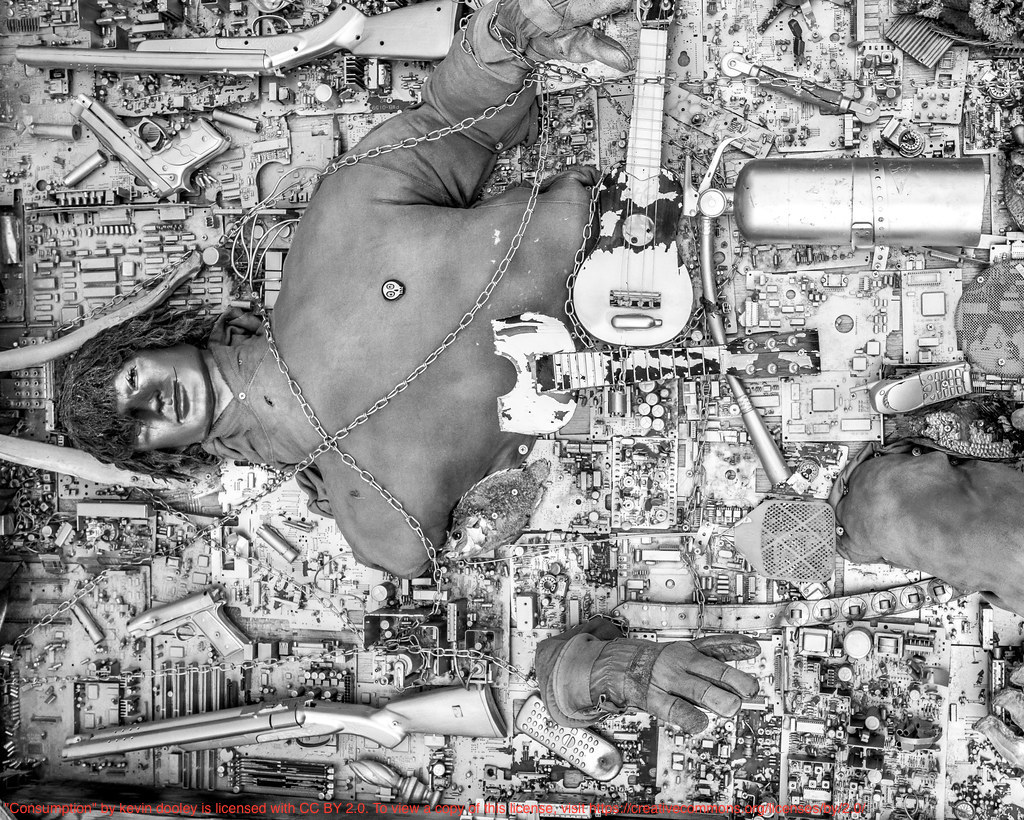



A quarter of America is a dramatic, tense, violent country, exploding with contradictions, full of brutal, physiological vitality, and that is the America that I have really loved and love, but a good half of it is a country of boredom, emptiness, monotony, brainless production, and brainless consumption, and this is the American inferno – Italo Calvino
The video below is an excellent example of home-brewed innovation that leverages machine learning to solve a problem many know but for which there is no financial incentive to address — it is a long tail problem. And while this is not something anyone can do without some technical skills, the case study does give us a glimpse of the incremental changes to everyday life machine learning promises to make as the technology gets democratized.
Clever thinking of combining drone footage from the California fires effect on San Francisco (September 2020) with music from Blade Runner.

Hurry, and you won’t arrive. – Chinese Proverb




Love walking through San Francisco. Nuggets of art peppered throughout the city.
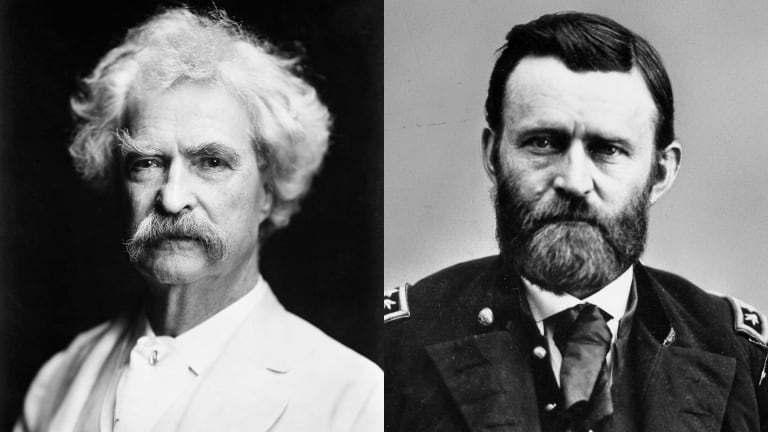
In his autobiography, Mark Twain elaborates on his relationship with General Ulysses Grant. Twain notes that the general enjoyed a high level of popularity and respect worldwide. After a trip to China, Twain explains that the political elites in that country admired and respected Grant.
When a new, more conservative regime came into power in China, they recalled all of their citizens studying abroad back home. Those in favor of continuing the foreign study program appealed to Grant for help. Grant wrote a letter to the new leadership in China, and they, out of respect for him, reversed their decision (“Grant and the Chinese: note for 72.33–34,” in Autobiography of Mark Twain, Volume 1. 2010).
The friendship between Twain and Grant was strong, and Twain was not only fond of Grant but admired the man and his deeds as a Union leader during the Civil War. This fondness and admiration made the reality of Grant’s financial circumstances frustrating and troubling for Twain.
Twain recalls his suggestion that Grant document his experience during the Civil War in a series of memoirs. Grant resisted this idea out of modesty. He thought no one would want to read about his background and feared it would come off as boasting. This modesty annoyed Twain, who viewed the accounts as invaluable and a matter of national pride and a treasure for future generations. Twain argued that there was good money to be made by Grant, the former president pushed back that he was financially well off and had everything he needed.
A while later, Grant and his family found themselves broke due to a series of bad investments they made with a person they thought was a friend but was nothing more than a swindler. When Twain got the news that Grant was writing articles for a publication to help make ends meet, he immediately approached Grant and his son and revisited the idea of having Grant write his memoirs. Grant informed Twain he was ready to sign a contract with the publishers of his articles. Twain asked to read the agreement, and he found that Grant was severely getting underpaid. He provided Grant a market value proposal, and Grant signed with Twain’s publishing company.
Twain offered Grant $25k advance for each manuscript upon delivery. And the money was Grants even if they did not meet a minimum number of sold books. Grant refused because he found it unfair that he should get that money, and the publisher loses because of low sales.
Twain goes on to say, “It was absolutely impossible for him [Grant] to entertain for a moment any proposition which might prosper him at the risk of any other man.”
The Autobiography of Mark Twain is a series of three books and is part of the Mark Twain Project. It is an exhaustive work that can be consumed all at once or in bits and pieces. It is an American treasure and holds some of the best American histories once can read. From time to time, I will be posting brief summaries of those stories, and I urge you to go read them yourself. I can do no justice to Twains exquisite writing. Trust me, you will be well rewarded for putting the time into reading about this great American hero.
 CYBERTONIA