
The secret to having no worries, at least where I am concerned, is to have plenty of ideas — Eugene DeLacroix
The secret to having no worries, at least where I am concerned, is to have plenty of ideas — Eugene DeLacroix

Books are not made to be believed, but to be subjected to inquiry. When we consider a book, we mustn’t ask ourselves what it says but what it means. – The Name of the Rose

Opinion = information + predisposition — John Zoller

You are neither here or there / A hurry through which strange and known things pass. — Seamus Heaney

The way we face the world alters the face we see in the world — David Whyte

In Nail Ferguson’s 2012 book, Civilization: The West and the Rest, he tackles why the West succeeded, to the degree it has and has come to dominate the globe? After a detailed outline of how the European powers compared to those of the Ottoman and Chinese empires 500 years ago — not well. Ferguson goes on to detail how, through circumstances of violence, poor decisions, and empirical overreach, the well-established Chinese and Ottoman empires created the right conditions for the rise of Western Civilization and its 400 years of dominance. He describes 6 particular developments that separated the West from the rest, which in keeping with the times he describes as “Killer Apps.” (This will make more sense in a few). Here are Ferguson’s civilizations killer apps:
I’ve read reviews of this work dismissing its oversimplification on one end and its Western-centric position on the other. I think the former missed the point of the exercise while the latter likely didn’t read the text because Ferguson’s conclusions are far from flattering for where the West is heading.
I enjoyed his framing the social developments that gave rise to Western Civilization as Killer Apps. In doing so, Ferguson illustrates how these can and have been downloaded by the rising powers — China for one.
Ferguson spends a good deal on the colonial period and the horrors they incurred on native peoples and also highlighted some of the benefits that came out of said periods, particularly around medicine.
Below is a TED Talk by Ferguson where is discusses his killer apps. He is a master presenter, and his summary of the apps is compelling and informative.
Ferguson does not shy away from the horrors delivered by Europeans as they marched and conquered the world. These horrors were critical in establishing and maintaining their dominance. But Ferguson did fail to identify an operating system for his apps. I would call it OSR, the operating system of ruthlessness. Without ruthlessness, empires cannot retain their hold for too long, and the rest of the killer apps would not have had an operating system on which to run.
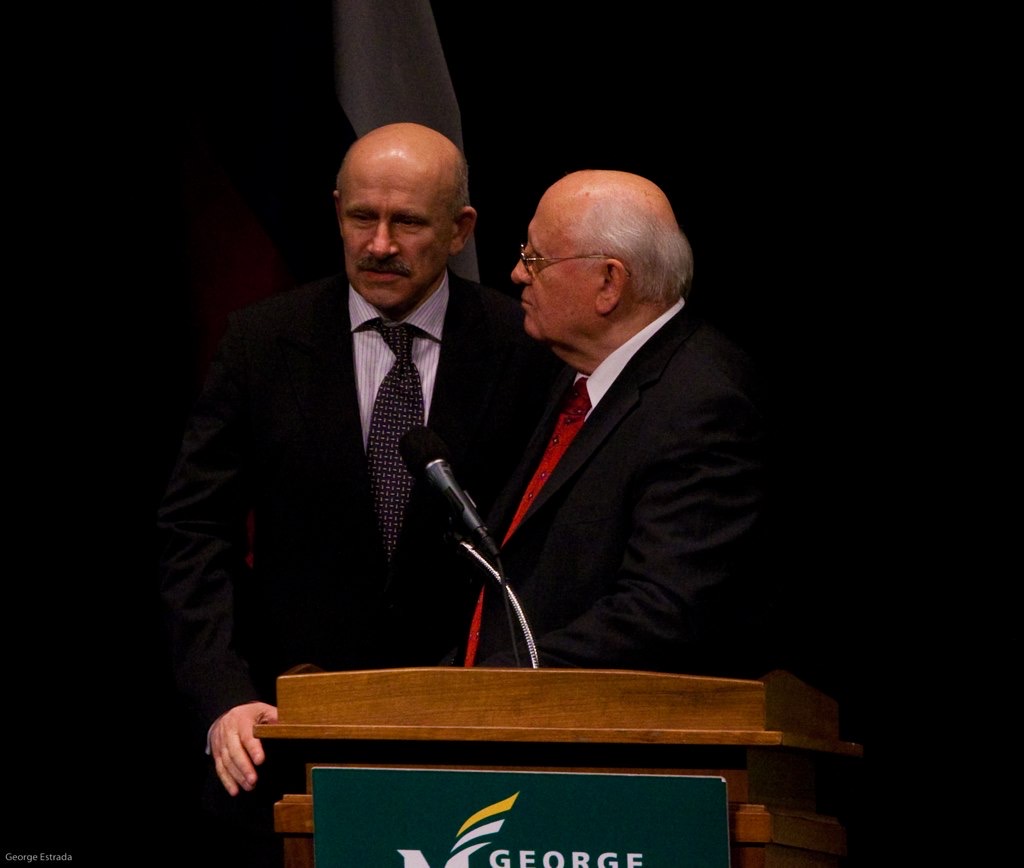



I had the opportunity to watch Mikhail Gorbachev speak at George Mason University back in late 2008. I don’t remember the exact topic of his lecture, but there were some grumbles about the war on terror and how the US mishandled the post-Soviet era.
I was particularly fascinated by Gorbachev’s insistence that communism was and is still a sound system. Faithful to the end, the man did not waiver on his ideology.
After watching the HBO miniseries Chernobyl about the Ukraine nuclear plant meltdown in 1986, I find it hard to believe that so many on the American left continue to view Gorbachev with such esteem. I don’t know much about the man outside of superficial articles on him and what I remember as a teen and current events at the time. I suspect that he had decent intentions and, like all political leaders had as much nasty to him as his counterparts.

A man went in search of fire with a lighted lantern. Had he known what fire was he could have cooked his rice much sooner — Zen Parable

Washington Post article on the use of AI in weapons systems. Well written and timely. But I feel that the concerns come too late. It is unlikely that the US or any other power will walk away from using AI in their weapons. Given the proliferation of AI systems, anyone that does will be at a disadvantage.
In March, a panel of tech luminaries including former Google chief executive Eric Schmidt, then-chief of Web services, now chief executive of Amazon Andy Jassy and Microsoft chief scientist Eric Horvitz released a study on the impact of AI on national security. The 756-page final report, commissioned by Congress, argued that Washington should oppose a ban on autonomous weapons because it would be difficult to enforce, and could stop the United States from using weapons it already has in its arsenal.
Washington Post: The U.S. says humans will always be in control of AI weapons. But the age of autonomous war is already here — By Gerrit De Vynck
The key will be how tightly the protocols lead from one stage or escalation to another. If AI systems can make decisions that escalate into using powerful weapons of mass destruction, including nuclear, then we are fucked. There has to be a man-in-the-middle approach that buffers how far and fast the AI systems can go. But it is safe to assume that battlefield engagements will have AI systems running point.
The frustrating aspect of this subject is that the speed that technology continues to move leaves very little time for society to review and sensibly argue the ethical implications. Now, anyone who reads science fiction knows that these topics have been covered in detail by writers for decades, but our leaders and society have dismissed these stories as fantasy. Now they have come to reality.

Boat at the mouth of the Miami river. Lovely sunrise.
 CYBERTONIA